Arguendo

Arguendo is the Core Project in the Lex Coterie Group of Organizations.

Monday, 26 January 2015

ONLINE COURSE ON INTERPRETATION OF CONTRACTS AND STANDARD CLAUSES IN AN AGREEMENT

In this course, you can learn important principles related to interpretation of contracts and various techniques for drafting standard clauses in an agreement. The Course aims to offer a unique blend of theoretical aspects of interpretation and practical aspects of drafting in one package. Here we introduce you with all the standard clauses in an agreement and their divergent forms, along with the legal implications and drafting techniques. The Course is based on practical learning experiences of our contributors working at some of the reputed law firms in India.    

The course is intended for law students, fresh law graduates, and legal professionals of less than 4 years PQE who are desirous of fine tuning their drafting skills and broadening their understanding of crucial terms in a contract.  

About the Course

The idea of drafting a contract with a given template based on a bare term sheet may sound very easy to any fresh law graduate or even a lay man. It actually is, as long as there is hardly any application of mind and it is done in a mechanical manner. There are several invisible ingredients which go into the raw term sheet or a basic template before the final recipe is ready to be served to the client. Some of the obvious ingredients are, your knowledge and understanding of the subject and business practices prevalent in a particular industry, hard earned experience, and foresight as to how the Court may interpret the same.
As a legal professional the first thing you are expected to do is apply your mind, and that is what makes you a true lawyer. A mechanical copy-paste job will always get you in trouble. Therefore, when you draft an agreement, it is very important to be aware of how a judge would interpret it, if ever, a dispute arises and the agreement hits the court of law. Furthermore, a standard clause couched under the protective cover of ‘Miscellaneous’ at the fag end of the contract, may not always be standard. There may be deceptive divergent of the standard clauses which can easily skip your attention. Therefore, to avoid any kind of dispute, a smart lawyer would always draft a contract without any loose ends, i.e. a contract which may be subject to several interpretations, in particular the one which may prejudice the interest of his/her client.
The present course aims to give you a very comprehensive understanding of standard clauses in a contract and their interpretation. In addition, it also offers you several drafting techniques for these terms which you can use to suit your need and tweak the interpretation. The course also has all the essential elements of our maiden course on interpretation of contracts which received more than 300 applications from several law students and legal professionals across India last year. Above all, the entire course is based on leading judgments of various courts in Indian and practical learning experiences of legal professionals currently working at some of the reputed law firms in India.

COURSE STRUCTURE

PART-A: Interpretation of Contracts

P1310979-001CChapter-1: Fundamental Rules for Interpretation of Contracts
Chapter-2: Interpretative Value of Pre-contractual Documents/Draft Agreements
Chapter-3: Importance of Deleted Words
Chapter-4: Implied Terms of Contract and Business Efficacy Test
Chapter-5: Specific Provision vis-a-vis General Provision
Chapter-6: Harmonious Construction of Contractual Terms
Chapter-7: Placement of Clauses in a Contract: Does it matter?

PART-B: Drafting of Standard Clauses

Chapter-8: Clauses related to Interpretation and Private Definitions
Chapter-9: Representation and Warranties
Chapter 10: Indemnities, Liabilities and Remedies
Chapter-11: Confidentiality Clause
Chapter 12: Intellectual Properties – Ownership and Liabilities
Chapter-13: Dispute Resolution & Arbitration Clause
Chapter 14: Miscellaneous Provisions, viz. Assignment, Severability, Entire Agreement, Waiver, Survival, Amendment, Counterparts, Force Majeure, etc.

ELIGIBILITY

  • Any law student who is in the 2nd-5th year of 5 years’ B.A./B.Sc/B.Com LL.B course from a recognized law school or university;
  • Any law student in the 2nd-3rd year of 3 years’ LL.B course from a recognized law college or university;
  • Fresh law graduates and legal professionals with less than 4 years’ PQE (Post Qualification Experience);

SELECTION CRITERIA & RULES

  • A total of 50 applicants will be confirmed on first come first serve basis upon successful payment of the applicable fee on or before the last date of enrollment, i.e. February 8th, 2015.
  • The interested candidates can send their application through an email to indiancaselaws@gmail.com with the following details- (a) name; (b) name of the college/university; (c) year of passing; (d) contact address and, (e) mobile number.

REGISTRATION & PAYMENT

  • Once the application is received by us, a confirmation email will be sent to the candidate, upon which the selected candidate can pay the application fee to the following bank account- A/c Holder Name: Ashutosh Kumar, A/c No. 4044 0015 0005 1965, IFS Code: PUNB0404400.
  • After making the payment, kindly send a receipt/ challan/ screen-shot/ any documentary proof of the same so that we can confirm your application at the earliest.
  • A candidate discontinuing the course or failing to take the evaluation test will be automatically disqualified from the course upon which no fee shall be refundable to them.

CERTIFICATE OF COMPLETION & OTHER REWARDS

  • Upon successful completion of the Course, the candidates will be issued a ‘Certificate of Completion’ within one week from the date of declaration of results.
  • Among the successful candidates of this course, top 10 candidates shall have access to the selected legal resources of Indian Case Laws for one year.
  • Among the successful candidates of this course, top 5 candidates can also avail the opportunity to do either (a) 2 months’ online internship with Indian Case Laws, or (b) work as research scholar at Indian Case Laws.
  • Candidate securing the highest marks in the evaluation test will have the opportunity to get his article published in International Journal of Legal and Social Sciences (ISSN 2394-1936).

COURSE FORMAT

The course will primarily consist of study material in the form of e-books and manuals. You may be required to devote 3-4 hours of study in a week. The Course is intended to be completed in a span of two weeks starting from March 15, 2015. At the end of the course there will be an evaluation test based on which the candidates will be issued a course completion certificates.

EVALUATION TEST

The evaluation test would include submission of research project for Part A of the course and drafting of an agreement for Part B of the course. The minimum qualifying percentage for clearing the test is 55%.

COURSE FEE 

  • Law Students: INR 500/-
  • Fresh Graduates: INR 700/-
  • Legal Professionals: INR 900/-
CASH BACK: The first ten confirmed applications will be eligible for a cash back of 20% of the application fee upon successful completion of the course. Similarly, the next ten (i.e. 11-20) confirmed applications will be eligible for a cash back of 10% of the application fee upon successful completion of the course.

IMPORTANT DATES

  • Last Date for Enrollment: February 28, 2015
  • Course Duration: March 15 – March 31 (2 weeks)
  • Evaluation Test: 1st week of April
  • Declaration of Results: 2nd week of April
  • Issue of Certificate: 3rd week of April

Sunday, 25 January 2015

Indian Constitution 101: A Visual Journey

The Constitution of India is probably one of the least read of texts in India. It enjoys neither popular affection, nor particular appreciation. However, the original book that is this painfully-detailed mammoth text, is a piece of art in its own right.
While the main body of the text is something we are all vaguely aware of, thanks to civics classes in school, the artwork that details each page of the original book is something most of us are unfortunately unaware of.
Through this piece intends to focus on the images and the artwork that is an integral part of the Constitution and unravel the meaning behind each image and each piece of art, thereby, further adding meaning and layers to the otherwise tediously boring sounding words.
The Constitution is a fusion of a  historical document with a contemporary writing style which needs to be made more accessible, eliciting greater appreciation and recognition.
Here's the catch. We don't like to read much. So I have taken up the challenge to write a description of the images in 140 twitter-worthy characters.


There exists a hand written edition in both Hindi and English of the Constitution of India


What is a constitution and why do we need it?

The constitution of a country is a set of written rules that are followed by the citizens of the nation. It is the supreme law that determines the relationship between the citizens and the government. It generated a degree of trust and coordination required for enabling a diverse population living together in harmony. Constitution also specifies the formation of government and the structure of power distribution. It not only states the rights of the citizens but also expresses their aspiration and visions for creating a better society.

Before we begin the visual journey,let us glide through some popular facts about the Constitution of India.

It is the longest constitution with 448 articles, 12 schedules and 94 amendments.
On 29 August, 1947, a committee for drafting the constitution was established.Dr. B.R. Ambedkar was appointed as the Chairman of the committee
After the constitution was presented to the Constituent Assembly, they took two years, eleven months and seventeen days to pass it.
As many as 284 members of the Constituent Assembly had signed the documents on January 24, 1950. Two days later, the constitution came into effect.
On January 26, 1950, the Indian Government also adopted Sarnath, the Lion Capital of Ashoka with the wheel, bull, and horse as the national emblem of India.
And, it is the only constitution in the world which has images.

The details and text makes it an art of a different kind.


The Hand-crafted Indian Constitution

Let us start with a question. Were you aware that the original Constitution of India was not printed but handwritten?

Don't worry. You ain't the only one. A majority of the Indian population is  not aware of that fact. The exquisite original hand-crafted constitution was a product of artistic inventiveness of Acharya Nandalal Bose and his student from Kala Bhawan in Shantinikentan over a time period of five years.


A glance through the artist history

Prem Behari Narain Raizada did the calligraphy using a holder and nib, (303 no. nib). The Government of India had allotted him a room in Constitution House where he completed this prestigious work, for which he did not charge any fee. Shree G. Mavlankar (first Speaker of India) had written in a letter – “I must mention that he (Raizada) did the work merely for his love of art & his country, without any demand or expectation even of remuneration”. The only condition he had was to be allowed to write his name on the bottom of each page.
Along with his students, Nandalal Bose in Shantiniketan, took up the historic task of doing the art work for the original handwritten version Constitution of India. In addition to planning and providing the leadership for this ambitious work, Nandalal Bose himself painted the major images.
The “Preamble” page, arguably the most important one in the constitution, was done exclusively by Beohar Rammanohar Sinha and it bears his signature, Ram, in the Devnagari script. Beohar Rammanohar Sinha initially did not sign it, but his teacher, Nandalal Bose insisted that the former must sign the page so that future generations are able to recognize, remember and celebrate the artist who ornamented the face of the Constitution of India.
The Preamble with the signature of Ram. He significantly contributed to the execution of line-drawings and gold-works that bear Nandalal Bose’s signature “Nand”.


 A minor analysis of the images.

Pages of the Constitution are embellished with highly stylized decorative borders, headers and backdrops. The complex decorative patterns in the borders and in front and back covers, embossed in gold on leather, are reminiscent of the Ajanta ceiling murals. 
At the beginning of each part of the Constitution, Nandalal Bose has depicted a phase or scene from our national experience and history.

Nandalal Bose has taken us through a veritable pictorial journey across four thousand years of rich history, tradition and culture.
The art work and illustrations (twenty two in all) rendered largely in the miniature style.

Represent vignettes from the different periods of history of the Indian subcontinent ranging from the prehistoric Mohenjodaro in the Indus Valley, the Vedic Period, the Gupta and Mauriya Period and the Mughal Period to the national freedom movement. 

The Vedic period is represented by a scene of gurukula (forest hermitage school).

Epic period by a visual of Rama, Sita and Lakshmana returning homeward.


Trivia: This image of Ram, Sita and Lashman was used to for a verdict for the 'Ram Janmabhoomi' dispute. The court declared Ram to be a Constitutional entity as his image has been used in the constitution.

Another Kalabhavan artist who is said to have contributed to the art work of the original handwritten constitution was Kripal Singh Shekhawat from Rajastan.

The constitution portraying the epic period by image of Krishna and in battlefield.

There is a beautiful line drawing of the Nataraja, as depicted in the Chola Bronze tradition.

Other important figures from India’s history include Akbar, Shivaji, Guru Gobind Singh, Tipu Sultan, and Lakshmibai

.
The freedom movement is depicted by Mahatma Gandhi’s Dandi march and his tour of Noakhali as the great peacemaker, and of Netaji Subhas Chandra Bose.

Snippet of history: the page that describes the commencement of the constitution.

The illustrations and the decorative borders are quintessential of the Santiniketan (Kalabhavan) style, which in turn was greatly influenced by the cave paintings of Ajanta.

In many ways, this original hand crafted Constitution of India represents one of the triumphs of Shantiniketan and Kala Bhavan.


If you found the constitution of India exotic and intriguing read the entries in detail over here.

About The Author:
I am Sneha Nanavati and I am a bibliophile. I am an obsessive compulsive dreamer guided only by my zeal for learning new skills.I like to live my life to fullest and dedicate my soul into what I do. I love to voice my opinion and would not settle for anything less that the best. I love creativity intermixed with a heavy dose of analytic and fact based information. I am quite inquisitive, determined yet sceptical by nature. I hopelessly love to lose myself in the world of books and selected telly shows. I love to be a medium for change and progress of a community as a whole.


[This article has been republished from its original source, The Campus Diaries, with due permission of the author]

The Curious Case of Google Books (Authors Guild v Google Books)


Google Books has been into news, not for the snippets of information that it has been supplying, but for a very long and protracted litigation, whose end does not seem near. While many of us may be using Google Books, not many will have an idea about the battle that it has been embroiled in for the past decade. In order to get a clear picture of the legal dispute, it becomes necessary to understand what is Google Books and what it does. Google Books is a decade-old service that has created a digital library of books by scanning them and making some portions available online. It searches the full text of books that Google has scanned and stored in its digital inventory and makes them available to users in snippets. The users are required to pay for accessing the entire book. The service also offers data mining- a procedure by which researchers can study the frequencies of words and phrases, syntactic patterns and thematic markers over a period of time to analyze the various changes that have taken place. The books are supplied by publishers and authors, or by Google's library partners, through the Library Project. The service was hailed by students, academicians and researchers as they could access, at least in part some books that were hitherto unavailable. 

So far as authors willing provide their books to the venture, it was not a problem. The bone of contention in this issue is the Library Project, which scans works with library partners and adds them to the digital catalogue. Under this project, Google has scanned around 20 million books. In 2005, the Authors Guild (AG) and the Association of American Publishers (AAP) filed a class action suit in the Southern District Court of New York in the US alleging copyright infringement by Google as the Library project included not only books that were in the public domain, but also copyrighted books. Moreover, it did not obtain permission from the copyright holders prior to scanning the full text of their books. After a long seven-year battle, the parties tried to settle in October 2012, whereby publishers could choose whether to make their books and journals available for Google’s Library project and Google agreed to pay $125 million. However, the settlement was rejected by the court. The court held that a prima facie case of copyright infringement was made out against Google. Google took the defence of the doctrine of fair use. Fair use serves as a defence to copyright infringement. However, certain conditions must be satisfied before an act can be considered fair use. These include-

 Nature of the use, i.e., whether it is commercial or for purposes like research and education
 Whether the use is transformative, i.e., if the use adds to the existing work 
 Volume of the portion used compared to the whole
 Whether market value of the original work has been affected 

On the nature of the use, the court said that although Google was deriving profits out of the venture, but at the same time, it was serving educational and research purposes. The court ruled that the use by Google was transformative because it converted text into digital form and used data mining. The service was not replacing the original work, as only snippets were made available. So far as the third requirement, although Google scanned books in their entirety, it made available to the users only a limited portion out of the whole. Regarding the effect on the market value of the original work, it was ruled that Google Books provided publicity to the works and thereby increased the users for the original work. It was finally ruled that the use fell within the ambit of fair use. Judge Denny Chin of the 2nd Circuit U.S. 

Appeals Court therefore dismissed the lawsuit filed by Authors Guild.The Guild appealed against the order by stating that Google Books could not be afforded protection under the fair use doctrine because its activities were highly commercial in nature and it was adversely affecting the market for the original works by weakening the digital market for them. The court was not convinced by these arguments and said that most cases of fair use involve some element of a commercial nature. Also, it was of the opinion that digital licensing was not affected adversely and was possible. A detailed decision is still awaited. 

This decision would have wide ramifications for the Indian intellectual property landscape. This is because although India has more stringent conditions that must be met for a use to be considered as fair, it is feared that this decision will set a global standard for fair use. Indian authors and publishers are likely to win against Google in Indian courts, it remains to be seen what will be the long-term implications of the case.

About The Author: 

Kudrat Agrawal, is a second year student at National Law University, Delhi. Presently in the fourth semester of law school, she is interested in Business Laws and want to pursue a career in Mergers and Acquisitions. She is an avid writer and is working as an Editor with Lawctopus-Acdemike and is a  Sub-Editor with fuccha.in. She is currently experimenting with writing research papers and pursuing online courses. In her free time, she likes listening to music and reading. 

Samvaad. 26th to 28th June, 2015, New Delhi

Model Governance Foundation welcomes you to take part in ‘Samvaad’ which will be held on 26th to 28th June, 2015 in New Delhi. The theme for Samvaad is “Ek Bharat, Shreshth Bharat”. Model Governance Foundation is excited to host the event in cooperation with eminent organizations like Adhrit Foundation, Advitya Ventures, Agrasar Foundation, Alexis Society, Bharat Sansthan and India Leadership Institute. This three day event will focus on fostering leadership qualities amongst students and young professionals by opening a cross-cultural dialogue on issues of national and international relevance. Samvaad will also provide ample opportunities for business networking with visionary entrepreneurs and industry experts around the world. Each one of our speakers is an expert in their respective fields with years of experience. 


Join us at Samvaad for your chance to hear these specialists, as they share with you the latest trends, insights and strategies on various issues of their expertise.

Events:
Formal Events
 Debate
 Uniform Civil Code
 Misuse of Sexual Harassment Laws
 Call for Papers
 Interactive Lectures by Eminent Personalities
 Debating Sessions
 Group Discussions

Informal Events
 Life Mapping Exercise
 Leadership Development Conversation

Register Now HERE


Registered Office:
Model Governance Foundation, B-1/37,
Sector D, Priyadarshani Colony,
Sitapur Road, Lucknow - 226020.

For More Details Contact:

Akanksha Arora, Convenor: +91 9929451140
Garima Sharma, Co-Convenor: +91 9990255202
Rahul Rautela, Co-Convenor: +91 8376085251

Email india.samvaad@gmail.com
Facebook                     Twitter                           Website

Tuesday, 20 January 2015

Indian Liberals: An online archive of Indian liberal writing

We are delighted to announce the launch of IndianLiberals.in, an online library of Indian liberal writings by Centre for Civil Society. The portal was formally launched on 17 January 2015 at the 1st Annual Asia Students for Liberty Conference by Mr Arun Shourie, prominent journalist, author and politician.


The Indian Liberals stood for the liberty of thought and action and against central planning. In current scenario, such liberties are in constant threat, which is not any different to the hubristic actions of the central planners during the socialistic pattern of society adopted by the Nehru government. It’s of utmost importance to go back to these heroes of freedom and acquire their wisdom through their powerful writings.
IndianLiberals.in is an online library of all Indian liberal writings, lectures and other materials in English and other Indian regional languages. The material that has been collected so far contains liberal commentary dating from the early 19th century till the present. It is this content that we hope to preserve and disseminate, by building a digital liberal archive that hosts all Indian liberal material in one place. We aim to digitise 50,000 pages in total, supplemented by audio and video content of prominent liberals, including personal stories of the work and struggles of Indian liberals who lived through the planning era, that is lesser known to us today, if not totally forgotten already. The portal shall help preserve often unknown but a very rich Indian liberal tradition and understand the relevance of the writings in today’s context.
You can access collection of writings, videos, talks and lectures of:
It was encouraging and inspiring to have Mr Arun Shourie launch the archive. He said that “the portal reminds us that there has been a tradition in India for a liberal polity. It is almost a civilisational principle and it is facilitated by the fact that we are such a rich and diverse country. It is also important that we start using alternate media for getting our message out and the idea of documenting this tradition is a perfect beginning.”
Join us in our efforts to spread the message of liberty! This portal is made possible by the combined efforts of all of us, to identify and source the works of important India Liberals. Do send us your feedback and suggestions! Write to editor@indianliberals.in.
For more information, contact Samta Arora (samta@ccs.in | +91 99538 27773)

Tuesday, 13 January 2015

Call for Campus Associates: Legal Desire Associate Programme


About Legal Desire Campus Associate Programme:

An opportunity for students to act as liaisons between Legal Desire and their institutions. It is an
opportunity to develop professional, marketing, communication and leadership skills. The initiative
also  intends to use various engagements to develop relationship with institutes starting with knowledge awareness initiatives, student projects, curriculum enablement development tuned to current industry needs and collaborative research.

This will entail hosting of activities like workshops, events and build relationships with students,
faculty and professionals. Campus Associate will be interacting with industry experts, successful entrepreneurs and peers from across the country.

Campus Associates are provided training and professional development, leadership and management
opportunities, and are rewarded with awesome perks. What’s not to like? Join the team today!

Duration & Time Commitment:

12 months, the estimated time commitment is approximately 5-7 hours a week, with some variations throughout the term.

As a Legal Desire Campus Associate you can:

 Build valuable business and career skills like problem-solving, public speaking, and
communication.

 Expand your professional network, by working side-by-side with students, faculty, professionals
and Team Legal Desire.

 Express your passion for providing a student voice and helping your peers.

 Have your work published via Legal Desire portal, our magazine, Journal, social media outlets,
internal newsletters etc.

Eligibility Criteria:

Law Student of recognized Institution. We are looking for self-motivated and responsible individuals
with excellent communication skills. He/she should also be well networked and be able to engage with a variety of audience. Organizing and resourcefulness skills will also be an added advantage.

 Passion for Law

 Ability to give positive, encouraging and clearly targeted feedback to the people you interact with

 Ability to motivate and excite others

 Genuine interest in public interaction and organizing events

 Willingness to be a public figure. Your role is providing face-to-face guidance to professors and

students, so comfort with being “public” is very important

 Help Legal Desire to better understand your campus culture

 Build relationships on campus with faculty and student groups

 Champion the Legal Desire brand on campus


Work Responsibility:

 Promoting Legal Desire in your Institution and various Social Media Platforms.

 Serve as a strategic link between your college and Legal Desire. Assist Legal Desire team in

organizing a workshop/seminar at your campus.

 Make people aware of Legal Desire through social media and other resources you have.

 Submitting Articles and Research Papers.

 Collecting Articles for publication on Legal Desire Online portal, Quarterly Legal Journal and our

Monthly Magazine ‘Legal Desire Reporter’.

 Promoting Legal Desire Online Courses and earning flat 10-25% commission.

 Organizing Events in your Institution with support and sponsorship of ‘Legal Desire’ vice versa,

helping us organise events with sponsorship from your college.

 Conduct interviews of Dean, Director, Law Faculty, eminent Legal Luminaries visiting your

college/university, the guests arriving at your campus, etc. for the purpose of publication on our

website. You will be given recognition for the same.

 Collect feedback about legal desire from your faculty, students etc.

 Submit reports/pictures of events that take place in and around your campus.

 Share the latest campus happenings with Legal Desire.

Perks:

 A unique opportunity to earn during your student life.

 Stipend of Rs.1000/month paid on completion of half tenure.

 Paid tasks to earn during your tenure.

 Welcome Letter & Certificate of Appreciation

 Coffee with Founder and Legal Professionals.

 Registration fee for all the workshops/courses/events by Legal Desire will be fully subsidized for

Legal Desire Campus ambassadors

 Recognition of active Campus Ambassadors on our website.

 Internship assistance.

 Enhance your professional development, leadership, and communication skills

 Add the Legal Desire Campus Ambassador Program experience to your resume

 Rewards for Performance.

 Free Trips to National Legal Events like Seminars, Conferences and Moots as a Part of Legal

Desire Team to report the event with our Media Team.

 Free Legal Desire Shopping Credits to shop online law books and other services.

 Free Discount Vouchers for Online Certification Courses conducted by Legal Desire.

 Legal Desire Goodies & Gift Hampers.

Selection Process:

Applications are accepted on rolling basis. After review of applications by HR Department of Legal Desire,

the selected applicants will receive confirmation email and contract of work.

How to Apply?

Submit your resume with contact details to info@legaldesire.com with subject headline ‘Application for the post of Campus Associate’.

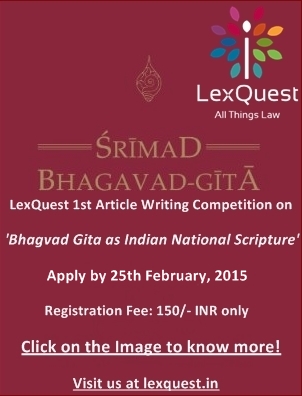
LexQuest 1st National Article Writing Competition, 2015 [Apply by 25th February, 2015]

LexQuest 1st National Article Writing Competition, 2015

Gita new
About: After the grand success of LexQuest 1st Essay Writing Competition, 2014LexQuest is pleased to announce LexQuest 1st National Article Writing Competition, 2015. A debate has been sparked off after the External Affairs Minister, Sushma Swaraj called for declaring Bhagvad Gita as a ‘Rashtriya Granth’ i.e. a National Scripture. We would therefore like to provide you with a platform to express your opinions about the issue.
Topic: Bhagavad Gita as Indian National Scripture
Eligibility: Any student pursuing any undergraduate, postgraduate or professional course in any recognized University/College in India.
Guidelines:
  • The word-limit for article is 2000 words (excluding footnotes).
  • It shall be in English only.
  • Each person can submit one entry only. Co-authorship is NOT allowed.
  • The Article shall not be plagiarized. Only the original articles will be considered for the competition. No part of it should have been published earlier nor should it be under consideration for publication or a contest elsewhere. Any form of plagiarism will result in disqualification of the article. The participants will submit a separate undertaking with regard to originality of work.
  • Copyright of the Articles shall rest with the organizers. Organizers hold the right to republish the articles if required.
  • Identification mark (name or any mark which identifies the author) must not befound in any part of Article.
  • Only Soft copy in MS Word file (.doc/.docx format) has to be submitted via email to info.lexquest@gmail.com
  • The email should carry the Subject-LexQuest 1st National Article Writing Competition, 2015.
  • The Article must accompany an abstract (not more than 300 words), Bibliography, cover page and a scanned copy of student ID card issued from institutions.
  • The Cover page of the submission should contain the following details only-
    • Name of the Participant
    • Contact Number
    • Email id
    • Institution
    • Course and Year of study
    • Permanent Address
    • Title of the Essay
    • Word Count of Abstract and Article
  • The main body of the Article should not carry any mention of the name or name of the institution. It shall be lead to immediate disqualification.
  • Last Date for submission is 25th February, 2015.
Format:
  • Font type: Times New Roman
  • Font size: 12
  • Line Spacing : 1.5
  • Page number: Top left of the page
  • Footnote size: 10
Registration
Visit: http://lexquest.in/lexquest-1st-national-article-writing-competition-2015/

Available Positions: Corporate Law Research Group [Apply by 15th January, 2015]


CLRG announces 2 Positions of Associates & 2 Positions of Senior Associates

Eligibility

  • Associates: Students from 1st Year LLB Hons to 3rd Year LLB Hons with good academic records
  • Senior Associates: Students from 4th Year and 5th Year LLB Hons with good academic records, internship experience and research skills.

The positions are not open for students registered in a 3 Year Law Degree Program.

Selection Criteria

1. Students having publications/ research experience will be given preference.
2. Shortlisting will be done on the basis of merit.


 LAST DATE: 15 JANUARY 2015


Saturday, 10 January 2015

The Plight Of Transgenders In The Global Prison System

You know them as gay, lesbian, bisexual, transgender – people are people.

Judith Light
A transsexual person is someone who lives or proposes to live in the gender opposite to the one assigned at birth.  The gender in which the transsexual person lives or proposes to live is known as that person’s acquired gender.[1] Moreover, the term  transsexual  has  a precise  medical  definition,  and  is  reserved  for  people  who  desire  to,  or  who  actually  do ‘transition’ to the opposite sex, by undergoing sexual reassignment surgery.[2]
This community is not only outcast outside in the world but also within prisons, where they are kept segregated from the general population. Transgenders usually face a lot of violence and abuse within the four walls of the prison. The violence is carried out more often by the guards than the inmates.This type of abuse usually take a form of sexual abuse. The issues and problems related with transgender incarceration have not gained much momentum for the simple reason that the community is marginalized and occasionally outcast. They thrive in ignominious darkness worldwide. Their voices are curbed if raised; they are underrepresented. No matter how well developed is the country; the Trans-genders still face challenges in terms of the behavior of the guards, authorities and inmates. This also includes the deteriorating health conditions they show while in prison. Furthermore, trans-genders have acquired genders, sometimes by undergoing surgery or by having hormone therapy.
Think of the situation when a trans-gender with feminine characteristics is forcibly thrown to a male ward, it is like keeping both male and female prisoners together. This piece is an attempt to analyze their sexual identities, the problems they encounter in the global prison system and the relevant legal frameworks. 


United Kingdom
A detailed new policy document drawn up by Kenneth Clarke's Ministry of Justice in 2011 requires jail warders to address inmates by courtesy titles such as Mister, must call transsexual prisoners "Miss" or "Ms" under the new mandatory guidelines. The 20-page guidebook, issued to prison governors remarked that "An establishment must permit prisoners who consider themselves transsexual and wish to begin gender reassignment to live permanently in their acquired gender.[3]"
From the point of view of the security, it is provided that if it emerges that a prisoner has been placed in the estate opposite to the legally recognized gender, a transfer must be arranged as soon as possible unless the prisoner requests location in this estate.[4]Not to forget, the Equality Act, 2010 stands for all types of gender discrimination in all types of places.Thus, we see that there are sufficient laws in hand for trans-genders inmates but nevertheless, they are suppressed in and outside the society.

United States
The courts have recognized that the underlying condition of gender identity disorder is real, and that the provision of medical care includes providing hormones and surgery in appropriate cases. In state prisons, transgender prisoners have frequently been denied any transition-related healthcare.[5]
Transgender people who have not had genital surgery are generally classified according to their birth sex for purposes of prison housing, regardless of how long they may have lived as a member of the other gender, and regardless of how much other medical treatment they may have undergone.[6]
Australia
Australian Human Rights Commission Act 1986 prohibits discrimination on grounds of sex. Similarly, there are gamut of other laws such as Victoria Equal Opportunity Act 1995, Western Australia Equal Opportunity Act 1984, Sex Discrimination Act 1984, et al which secure the rights of different sexes. Despite these, a lingering concern remains which is the management of trans-genders in prisons. They are denied required treatment at times, sometimes are subjected to prison violence.
What they can wear, the personal items they are permitted to purchase, the way in which  they  are  searched,  and  the  name  by  which  they  are  referred  to  by  staff  and  in  official prison records do not show a bright picture though.  At times, self- harms are also afflicted by them.

India
Recently, the Indian Supreme Court ruled that transgender people are a third gender.[7]Article 14 of the Indian Constitution as well many other Directive Principles of State Policy enshrine the spirit to provide all the genders an equal opportunity to nourish and flourish. The Bombay High Court had also considered to frame special guidelines for transgender prisoners as their issues need to be addressed effectively. What they complain is about the indifferent behavior of prison staffs. There has been a point made to have a special ward for these transgenders.
Conclusion
After going through the cases of the various prison systems around the world, one might wonder about the nature of problems every transgender face during imprisonment. (Though these are handful but enough to show the plight of the community.) The similar problems are amplified greatly in all these parts of the world. The ‘similar’ problems include the discrimination they face in prison wards if kept with other genders in the wards, the sexual abuse resulting from it, the denied medical treatment to them, the refusal to provide them with proper clothing, the bad attitude of the prison authorities towards them, legal underrepresentation, etc. These are the ‘general’ concerns and not the special ones. The inmates have their own peculiar and complex problems. It is to be realized that these people have just chosen their sexuality and they have every right to be with dignity and poise.The idea to open special prisons for these should be welcomed in India. The criminal justice system needs an overhaul in this direction as well.It is quintessential for their personal development. The need to answer a psychological question is felt here, if we have prisoner rights for both men and women then, why not for the ‘hijras’ as we refer to them?


[1] See Care and Management of Trans sexual prisoners by Ministry of Justice, UK
[2] Rebecca  Mann,  ‘The  Treatment  of  Transgender  Prisoners,  Not  Just  an  American  Problem—A  Comparative Analysis  of  American,  Australian,  and  Canadian  Prison  Policies  Concerning  the  Treatment  of  Transgender Prisoners and a ‘Universal’ Recommendation  to  Improve Treatment’ (2006) 15 Law and Sexuality: A Review of Lesbian, Gay, Bisexual, and Transgender Legal Issues  available at  http://www.wpath.org/Document2/socv6.pdf

[3]David Barett, Sex swap prisoners get right to bras and make-up available at

http://www.telegraph.co.uk/news/uknews/law-and-order/8363244/Sex-swap-prisoners-get-right-to-bras-and-make-up.html
[4] See supra note 1
[5]Chelsea Manning, Americas prison fails transgender inmates available at http://www.salon.com/2013/08/23/americas_prisons_fail_transgender_inmates/
[6] Ibid.

[7]YogitaLimaye, India court recognises transgender people as third gender available at


About The Author:


Aishwarya Dhakarey is a third year student at Symbiosis Law School, Pune. A keen and avid learner in life, she prefers to always associate herself with something really productive. Writing on diverse issues is her forte. She also loves to read extensively.